Built for companies that trade, build, make, move and store
Sensei suits a company whose work passes between several people before it becomes money: someone sells, someone buys or builds, someone ships, someone invoices and someone closes the month. Each industry has its own workflow, and any of them can be combined on one installation.
From buyer order to settled account
For companies that buy, stock and sell goods to other businesses, from one warehouse or several, with staff in sales, purchasing, warehouse and accounting.
What you gain
- Promises you can keep: an order reserves real stock, and what is short becomes a purchase draft
- Fewer wrong shipments: scans are checked against the pick list before dispatch
- Margin known when goods leave: cost is frozen on the delivery note at the moving average
- One customer statement that reconciles invoices, credits and payments

What it covers
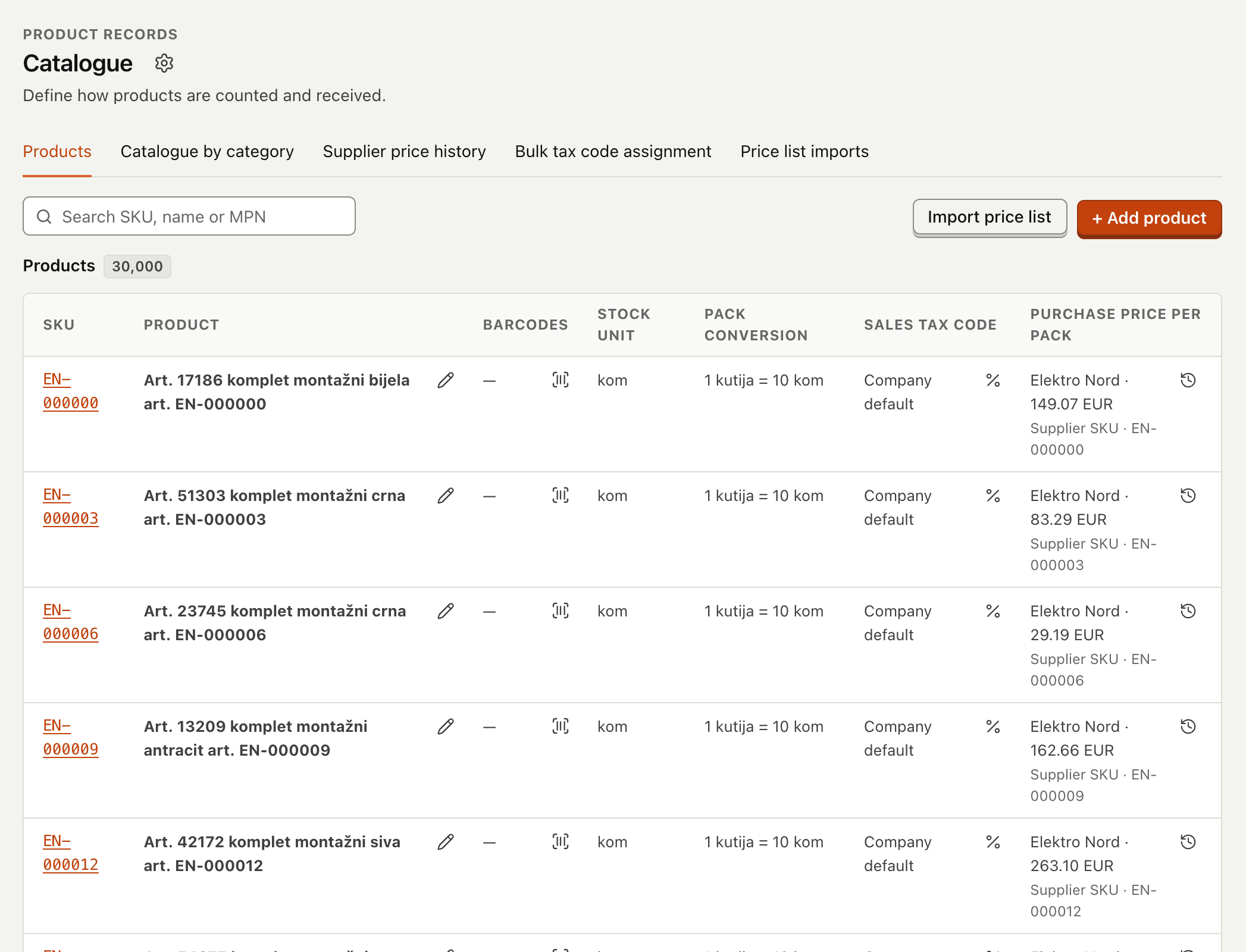
- Catalogue, supplier price lists and price history
- Customer prices with quantity breaks, quotes and credit limits
- Orders, reservations, backorders and split deliveries
- Picking, dispatch, delivery notes and invoices
- Lots, serial numbers and expiry dates
- Buyer portal, webshop, EDI and courier connections
A worked example
A buyer orders ten cartons at €22.50 against a €200 credit limit. Sales releases the hold with a reason. Nine cartons ship on Friday and the last on Tuesday. Two come back damaged: 24 pieces go to quarantine, a €45 credit is issued against the invoice, and the statement closes at zero.
From the product's acceptance scenarios, on sample data.
Price the job, run the site, know the result
For electrical, installation and building contractors and engineering firms that win work by pricing a bill of quantities and deliver it on site. No warehouse is required.
What you gain
- An offer with cost, selling price and margin on every line, from your own norms and suppliers' price lists
- The client's own Excel file returned with your prices filled in
- A job result you can open: materials, approved hours, subcontractor bills and overheads against revenue
- Site workers report progress without seeing prices or commercial documents

What it covers
- Estimates and calculations with a norm library
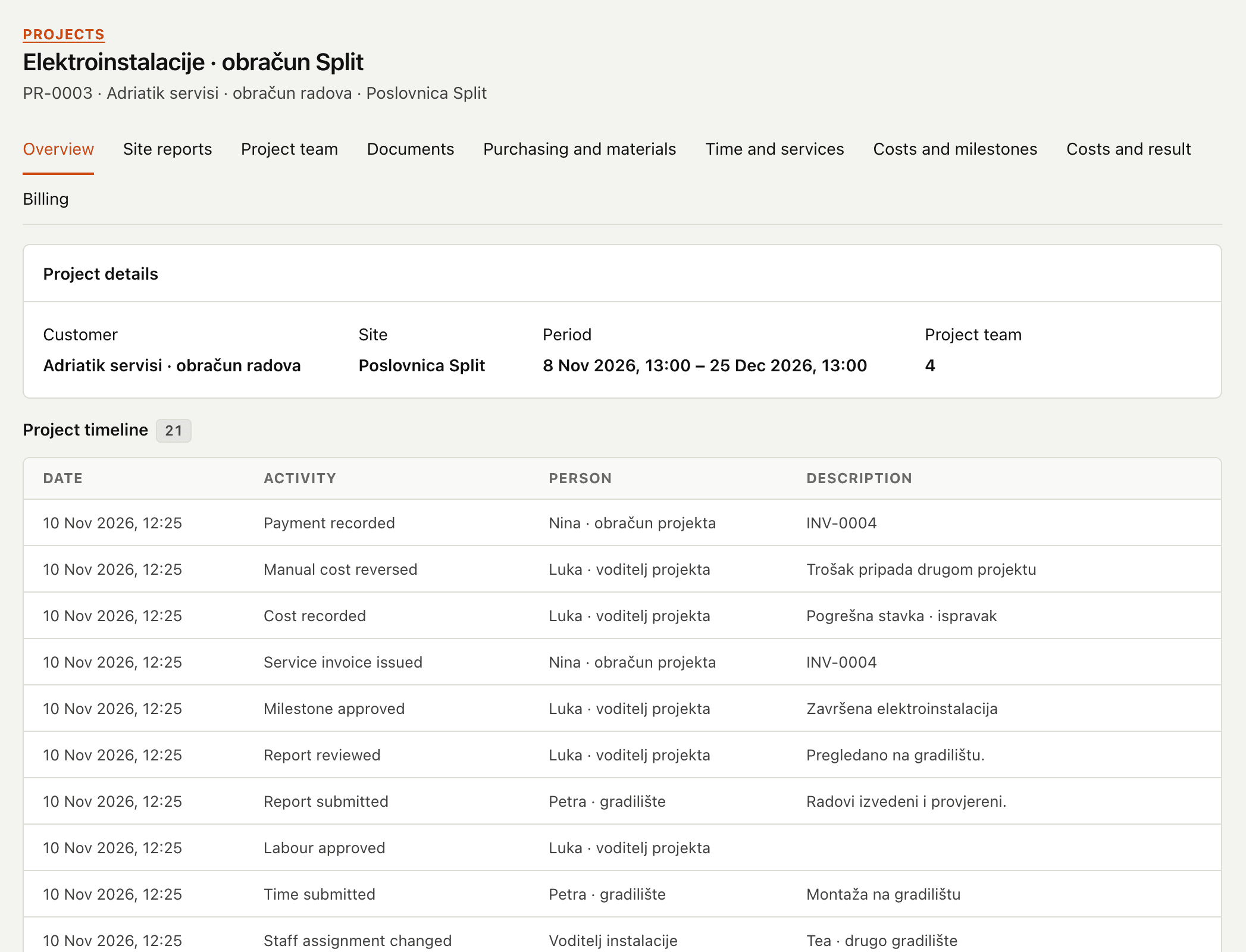
- Project with budget, team, milestones and documents
- Site reports with photos, reviewed by the lead
- Site material from stock or a linked purchase order
- Progress billing by executed quantities, with interim and final certificates
- Hours and materials against the estimate's plan
A worked example
A client's 60-line bill of quantities is imported. The norm library proposes norms for 44 lines; the offer is issued and accepted, and opens a project with its budget and plan. On site, a €1,000 milestone less €470 of recorded cost leaves a €530 result.
From the product's acceptance scenarios, on sample data.
Assembly at the cost it really had
For companies that assemble finished products from components to a bill of materials, alone or beside their own trading and project work.
What you gain
- The real cost of each finished piece, from materials issued, scrap and approved labour
- No surprises on the floor: releasing an order reserves its components
- A frozen recipe per order, so a later revision does not rewrite what was built
- Operators record work without seeing rates or values

What it covers
- Bills of materials and routings as published revisions
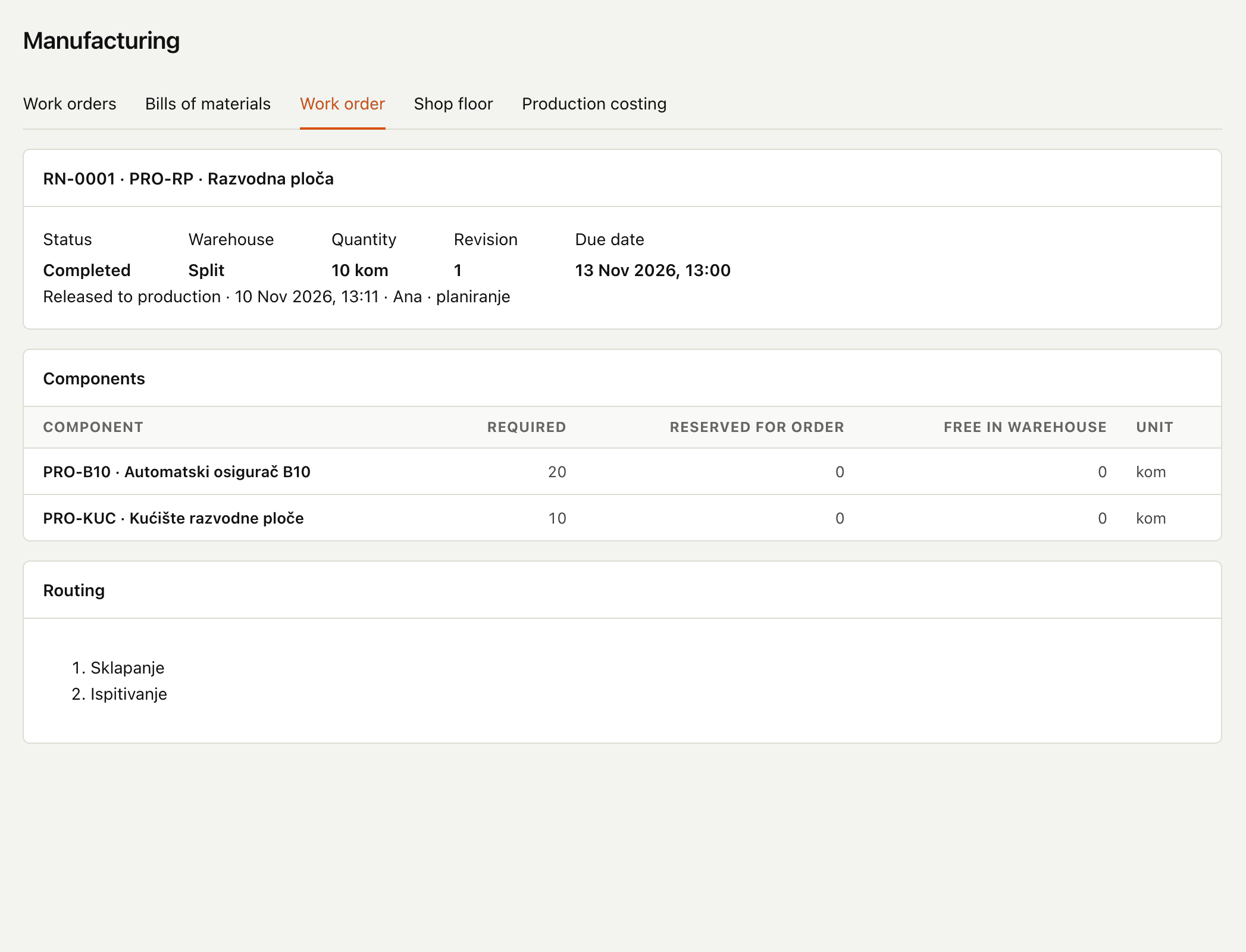
- Work orders with shortage review and release
- Component issues, scrap, returns and time per step
- Production costing: planned against actual
- Finished goods received into stock at actual cost
A worked example
A work order for ten distribution panels is released and its components reserved. Issues, scrap and time are recorded; completion receives ten panels at €184 actual cost, €18.40 each, ready for dispatch or for a project.
From the product's acceptance scenarios, on sample data.
Every job from booking to signed proof
For carriers that run their own vehicles, subcontract to other carriers, or both. It runs without a warehouse.
What you gain
- The margin of each job, frozen at closeout with its charges, carrier cost and proofs
- Proof of delivery with recipient, time and a signed document
- A clear decision on every exception: redelivery or return to sender
- Drivers see their runs, not the commercial rates

What it covers
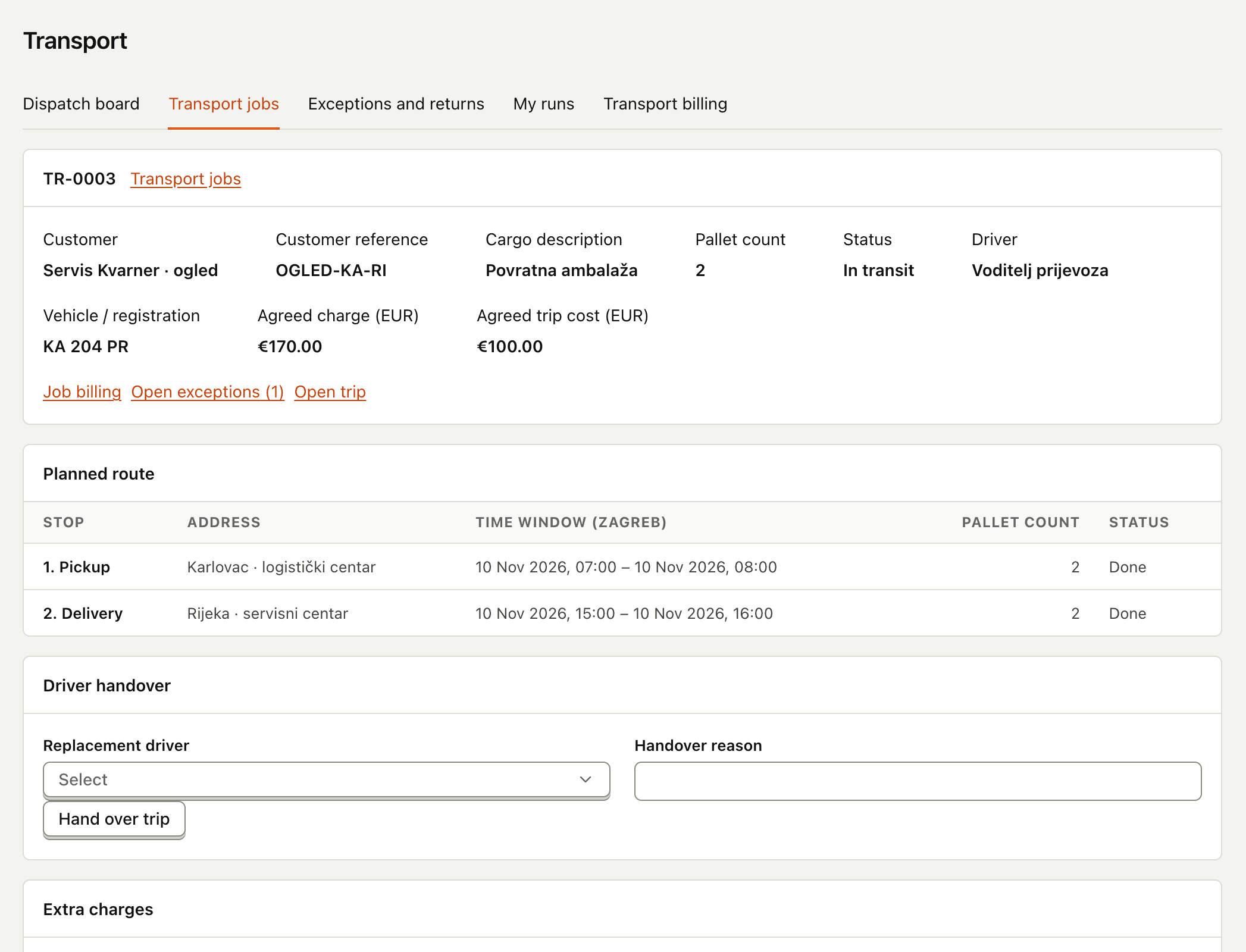
- Transport jobs with cargo, pallets, price and dated stops
- Dispatch board for unassigned, scheduled and delayed work
- Own vehicle or subcontracted carrier, with agreed cost
- Driver runs, handover and signed evidence
- Exceptions, returns and approved extras
- Billing closeout and invoice
A worked example
A ten-pallet job is booked at €700 and assigned to a subcontracted carrier for €480. A refused pallet is resolved with signed return evidence, and the job closes with a €220 margin.
From the product's acceptance scenarios, on sample data.
Other people's pallets, billed to the day
For warehouse operators that store and handle goods owned by their clients, on their own or beside transport.
What you gain
- A custody ledger that never mixes one client's stock with another's or with yours
- A monthly statement that applies each client's rates to every pallet-day
- Clients serve themselves: balances, release requests and statements in their portal
- A finalized month becomes one invoice, without retyping

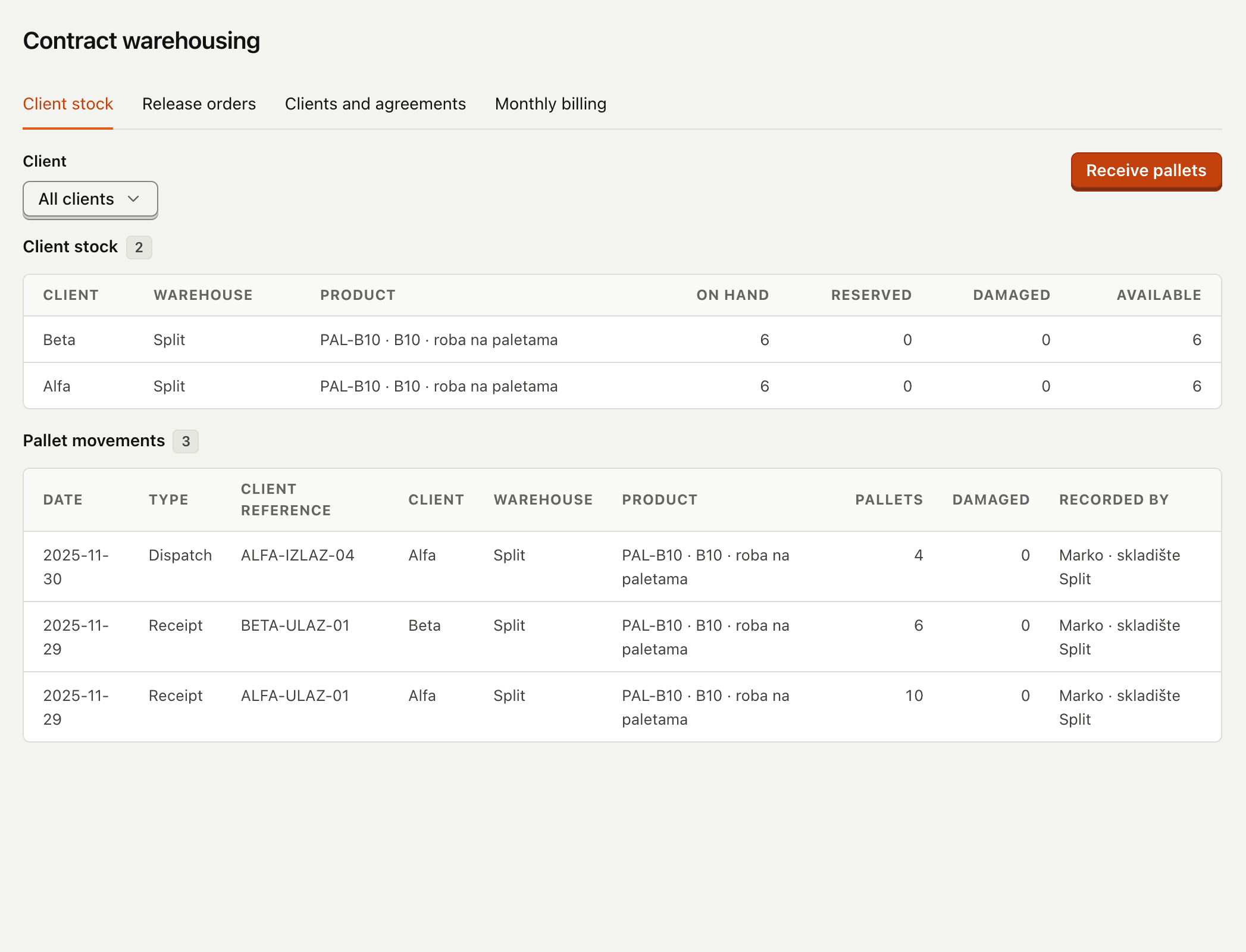
What it covers
- Clients with dated agreements and three rates
- Pallet receipts with client reference and condition
- Release orders, partial dispatch and withdrawals
- Client portal with scoped sign-in
- Monthly billing and finalized statements
A worked example
Two clients store the same product in one warehouse. Their pallets are received, part of one client's stock is released, and the month closes with statements of €56 and €30 at their agreed rates.
From the product's acceptance scenarios, on sample data.
Offers, contracts and tenders without a warehouse
For consultancies and other service firms, and for any company that bids on public tenders.
What you gain
- Every offer revision kept as issued, and the signed acceptance tied to the exact one
- Stage billing that shows what is agreed, invoiced, paid and still outstanding
- A tender file where every requirement has an owner, a deadline and its evidence
- A pipeline that counts each win once, wherever it came from


What it covers
- Sales CRM with contacts, opportunities and follow-ups
- Service offers at a fixed fee or by the hour
- Contracts, billing plan and stage invoices
- Tender register, lots, documents and clarifications
- Priced revisions, AI review, approval and submission receipt
- Handoff of a contract or a won lot to a project
A worked example
A €6,500 service offer is revised to €6,000, accepted with a signed copy and billed in two stages. A tender lot priced at 100 × €80 is amended to 120 × €80, approved with its evidence, and its €9,600 award is handed to a project.
From the product's acceptance scenarios, on sample data.
Not sure your business fits?
Tell us how an order or a job moves through your company today, and we will show you the same path in Sensei.